When you ask a small or mid‑sized company to hire you as a fractional executive, you’re not asking...
When people first step into fractional work, one of the first questions they ask is:
“How long is this going to take before I have real clients?”
It’s a fair question. You probably just left a salary, you’re staring at a blank calendar, and your LinkedIn inbox is full of people telling you they can fix that in a few weeks.
The honest answer, in my experience, is this:
Plan on six to eight months from first serious conversation to paid work.
Sometimes it’s faster. Sometimes it takes longer. But if you build your expectations and your plan around that 6–8 month window, you’ll make much better decisions.
Let me walk through why the timeline looks like that and what you should be doing in each phase.
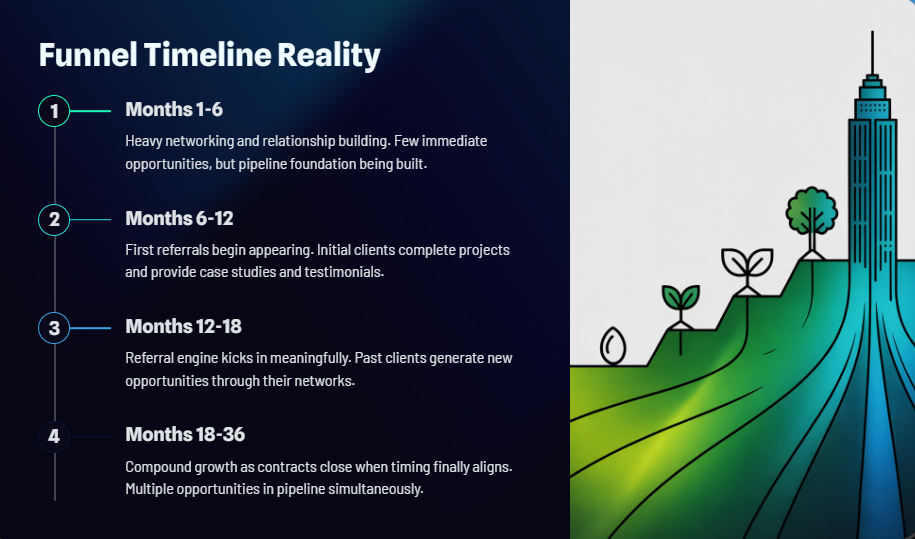
Phase 1 (Months 0–6): Heavy networking, zero “results”
At the beginning, your job is simple and uncomfortable:
Have as many relevant conversations as you can
Refine who you serve and what problem you solve
Start building a pipeline you can’t see yet
When I started, I set myself a basic activity target:
100 new LinkedIn connection requests per month to people who fit my ICP
Roughly 10 conversations per month with those who said “yes”
Those early conversations are not “sales calls.” They’re:
Discovery about their pains, gains, and jobs to be done
Validation that your value proposition actually lines up with anything real
Seeds for future opportunities, often 6–12 months down the road
For the first few months, almost nothing visible happens.
You talk to CEOs, founders, other fractionals. You explain the problem you solve. They say things like:
“That’s interesting. We’re in the middle of an ERP implementation right now. Maybe talk in the spring.”
“We’ve been thinking about that, but we just don’t have the bandwidth this quarter.”
“Can you send me some information and let’s touch base in a few months?”
If you go into this expecting a signed retainer in 30 days, that feels discouraging. If you go into it knowing the buying cycle is long, it feels like planting.
You’re not failing. You’re just at month three of a six‑to‑eight‑month process.
Why it takes so long
There are a few structural reasons the timeline stretches:
Buying committees, even in small companies
You might be talking to a CEO, but:
Finance needs to be comfortable with the spend
Operations needs to understand impact
Sales, HR, IT often have opinions
That internal alignment doesn’t happen overnight.
Competing priorities
Even when you’re a perfect fit, they’re juggling:
Existing projects (ERP, new plant, system migrations)
Cash constraints
Seasonal peaks in their own business
A CEO can decide “we want you” and still not have capacity until, say, April.
Risk mitigation
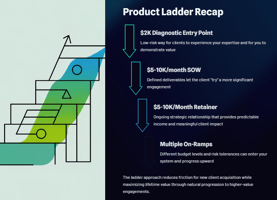
A fractional engagement at $8k–$10k/month is effectively a six‑figure annual commitment. Most owners want to:
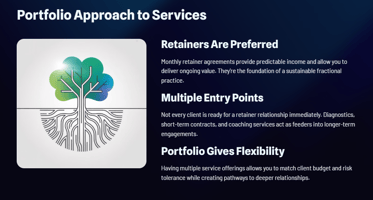
Start with a diagnostic or short SOW
See how you work with their team
Make sure culture fit is there
That adds another 60–90 days before a retainer is even on the table.
Phase 2 (Months 6–12): First referrals and delayed “yeses”
If you’ve stayed consistent for six months—connections, conversations, follow‑ups—something interesting starts to happen:
People you spoke to in April now have space in January
Your name comes up when a fractional CFO or COO hears “we need marketing help”
That CEO who wrote your name on a sticky note finally emails you
This is where you start to see:
Your first truly qualified “opportunity conversation” per month
They’re asking: “What’s your rate?” “When could you start?” “What would an engagement look like?”
Your first diagnostics and short SOWs
60–90 day projects where you prove value and both sides get to test the relationship
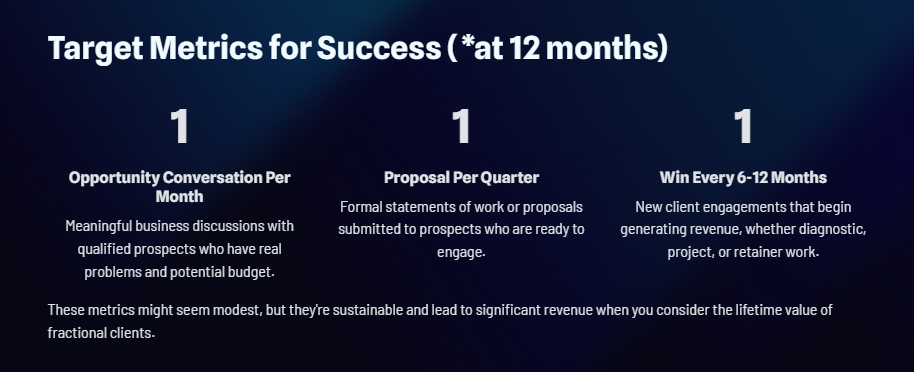
My own target here is:
~10 networking conversations per month
1 meaningful opportunity conversation per month
1 proposal per quarter
Out of those proposals, I aim to win roughly half. For my business and lifestyle, that translates into one new client every 6–12 months.
If your goals are bigger (four or five clients), you can scale the activity. The ratios don’t change much.
Phase 3 (Months 12–18): Referrals and capacity questions
As you move past the one‑year mark with consistent effort, you start to experience a different problem:
“If I land one more client, I’m not sure how I’m going to handle it.”
That’s actually the most common “complaint” I hear from people who adopt this approach and stick with it. They go from:
Zero clients and a lot of anxiety
to
Two or three solid clients, plus more opportunities than they can comfortably take
At this point, the 6–8 month cycle is still true for any new relationship, but:
Your referral engine is running
Other fractionals bring you in where they see your specific problem
Past diagnostics and SOW clients call you back for the next phase
Your portfolio decisions start to matter
Do you subcontract certain work?
Do you downshift a long‑term client to an advisory model?
Do you slow your outreach from 100 connections a month to 50?
Those are good problems. But you only get them if you’ve respected the earlier phases.
What you should actually be doing in those 6–8 months
If you accept that the ramp is real, the question becomes: how do you make that time productive?
Here’s the short version of what’s worked for me and for others who’ve followed the same model:
Get painfully specific about your ICP and problem.
“I can do 20 different things for 10 different industries” is not a business development strategy.
A single clear line is:
“I help 5–50M manufacturers who have a website and a CRM, but don’t know how to use them to find their next customer.”
Set weekly activity targets, not outcome targets.
Early on, you can’t control clients. You can control:
Connection requests sent
Conversations booked
Follow‑ups sent
Use every conversation to refine your value proposition.
When you talk to an owner:
Ask what’s painful right now
Ask what “solved” would look like
Listen to the words they use and feed that back into your pitch
Offer low‑risk, high‑value first steps.
A $1k–$2k diagnostic or a 60–90 day SOW:
Feels manageable to them
Gives you a way to qualify them (culture, expectations, fit)
Creates a natural bridge to a retainer if it goes well
Keep meticulous notes and a simple rhythm.
You don’t need a complex tech stack at the start. A spreadsheet with:
Who you talked to
What matters to them
When to follow up
…and a simple daily/weekly/monthly routine is enough.
Don’t confuse “slow” with “broken”
The biggest trap I see new fractionals fall into is this:
They start with reasonable outreach and networking.
Three months in, nothing obvious has closed.
They decide “this isn’t working” and go chasing a shortcut.
The reality is, at three months, you’re just getting started.
You’re still in the “introductions and planting seeds” phase. Most of the people you’re talking to simply don’t have the timing or headspace yet—even if they like you and the problem you solve.
If you reset your expectations around a 6–8 month arc, you’ll:
Stick with a process long enough to see it pay off
Make better choices about offers and pricing
Be much less vulnerable to “instant results” pitches
A closing thought
When I show this model to other fractionals, I usually get one of two responses when I follow up a few months later:
“I’ve been trying a bunch of other things that aren’t working. I need to go back and do what you described.”
“I’ve been doing exactly what you described. I now have two clients and a third in the pipeline, and I’m not sure how I’m going to fit them in.”
Both are useful data points.
The first tells you the 6–8 month reality is easy to underestimate.
The second tells you that, if you respect it, it works.
You don’t have to like the timeline. But you do have to design around it.