If you hang around fractional circles long enough, you’ll hear some version of this goal:
If you hang around marketing long enough, you’ll absorb the idea that every professional needs a newsletter.
Weekly, of course. Maybe twice a week if you’re really “serious.”
I don’t have a newsletter.
I don’t send regular email blasts.
What I do instead is something I’d describe as strategic interruption:
One highly relevant, high‑value email to a carefully chosen slice of my list, every few months.
In my experience, that works far better for fractional business development than a standard newsletter cadence.
Let me walk you through why—and what it looks like in practice.
The problem with newsletters in a fractional context
Newsletters can be useful in some models. But for most fractionals selling high‑trust, high‑ticket services, they run into a few predictable issues:
Inbox fatigue
The first couple of issues might get read. By email #5 or #10, even if the content is decent, a busy CEO is probably thinking:
“I like Rob, but I don’t have time to read this every week.” Best case, they set up a rule to file it into a folder. Worst case, it goes to spam.
Low signal, low timing alignment
A generic “here’s what I’m thinking about this week” doesn’t necessarily intersect with:
A real problem they’re feeling right now
The moment they have headspace to consider solving it
Hard to sustain at high quality
Writing something genuinely useful every week is not trivial, especially when:
You’re working with clients
You want to spend time on non‑work things
You’re not trying to build a media company
The result is often a slow decline in engagement—and, more importantly, a gradual erosion of attention.
When you actually have something urgent and valuable to say, you’re just another line in a crowded Promotions tab.
What “strategic interruption” looks like
Instead of a weekly cadence, I aim for something more like:
One relevant, substantive email to a selected segment every 4–6 months.
The key differences:
It’s not to everybody
It’s not on a fixed schedule they can get numb to
It’s about a topic that matters a lot to that specific group, right now
Here’s a concrete example from my own list.
The McKinsey email: 80 → 60% → 12 → 5 → 2 → 1
At one point, I had about 500 contacts in my CRM that I’d enriched and qualified:
5–50M B2B manufacturers
In geographies and segments I understand
With tech stacks and signals consistent with my ICP
Out of those 500, I pulled a segment of 80 that:
Had some form of e‑commerce presence
Sold through distribution
Matched a few other criteria that made them especially relevant to a topic I had in mind
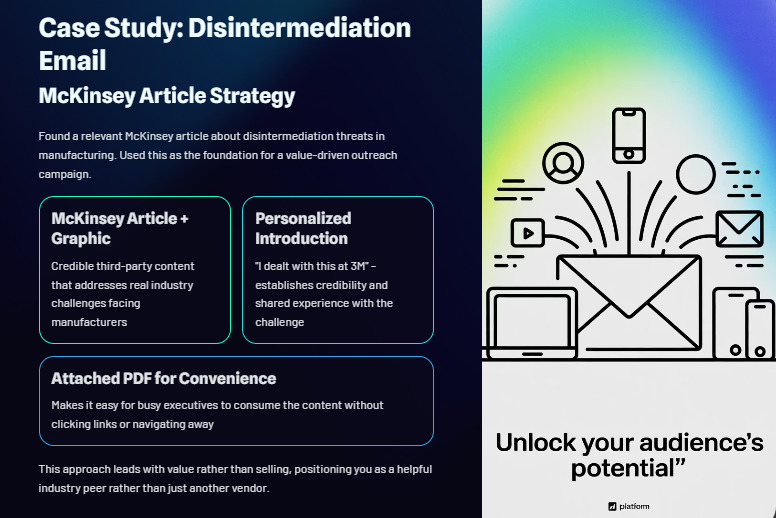
I’d just read a McKinsey article on disintermediation between manufacturers, distributors, and end customers in e‑commerce. It was excellent and directly related to a problem I’d lived at 3M.
So I wrote a simple email to those 80 people. It sounded roughly like this:
“We’re connected on LinkedIn; that’s why you’re hearing from me.”
“I came across this McKinsey piece on how manufacturers and distributors are navigating e‑commerce.”
“This graph in particular captures a challenge I used to run into all the time at 3M.”
“Here are 2–3 key points I think are especially important if you’re a manufacturer selling through distribution.”
“I’ve attached the PDF so you don’t have to go hunting for it. Hope you’re well.”
A few important details:
No pitch.
I wasn’t asking them to book a call. I wasn’t hinting at services. I was simply offering something I genuinely believed would help them think better about a real problem.
Attachment included.
I didn’t make them click through to a landing page or sign up for anything. The value was literally attached.
Plain, human tone.
It sounded like a person who knows their world saying, “This might matter to you.”
The results:
80 emails sent
~60% open rate (very high for B2B)
12 direct replies
5 real conversations
2 concrete opportunities
1 new client
That’s why I didn’t want to send it to all 500.
I only needed one more client at that point.
Why this works better than a drip for fractional work
A few reasons this pattern fits fractional business development:
High attention when you do show up
If I’m only in someone’s inbox two or three times a year, and each time I show up with something clearly valuable and tailored, they’re much more likely to actually read it.
Easy to justify internally
When a CEO forwards that email to their team, they can say:
“This is exactly the kind of dynamic we’ve been wrestling with. Read this and let’s talk.” That’s very different from, “Here’s Rob’s Week 27 newsletter.”
Aligned with long buying cycles
If your typical sales cycle is 6–8 months, you don’t need 26 touches a year. You need a handful of well‑timed, high‑quality ones.
Sustainable to produce
Finding or creating one strong, relevant piece of content every quarter or so is manageable while you’re running a fractional practice.
How to implement strategic interruption in your own practice
You don’t need a complex stack to do this. Here’s a simple way to start:
Build and enrich a targeted list.
Use LinkedIn + a CRM + simple research (or tools like Clay, if you’re inclined)
Aim for a few hundred people who:
Match your ICP
Have signals that make them especially relevant to your problem
Segment narrowly for each email.
Don’t send every email to everyone
For each topic, ask: “Which 50–100 people on my list will care most about this?”
Choose content that passes three tests:
It addresses a real, recurring problem your ICP has
It’s genuinely useful whether or not they ever hire you
You can explain why it matters in their terms, not just yours
Write like a colleague, not a marketer.
“Saw this, thought of you because…”
“Here’s what stood out to me…”
“Attaching it so you don’t have to dig for it…”
Don’t tack on a hard CTA.
You can end with:
“Hope you’re well—if this stirs anything up for you, happy to compare notes.”
But avoid:
“Click here to book a 15‑minute strategy session.”
Watch for replies, not just opens.
Opens are nice. Replies are what you’re after:
“This is timely.”
“We’ve been wrestling with this exact thing.”
“Can we grab 30 minutes to talk about how this applies to us?”
That’s your signal that the interruption was strategic, not spammy.
You’re not trying to be a publisher
I want to be clear: I’m not anti‑newsletter on principle. Some people do them very well.
But as a fractional executive, your primary job isn’t to be a content publisher. It’s to:
Understand a specific kind of business deeply
Solve meaningful problems for a small number of clients
Maintain a network and pipeline that match your capacity and goals
For that job, a few well‑timed, high‑relevance emails will usually do more for you than a generic weekly broadcast.
You’re not trying to occupy their inbox. You’re trying to be the person they think of when the right problem becomes urgent.
Strategic interruption gets you much closer to that.