If you hang around fractional circles long enough, you’ll hear some version of this goal:
One of the most common patterns I see when people leave corporate and go fractional is this:
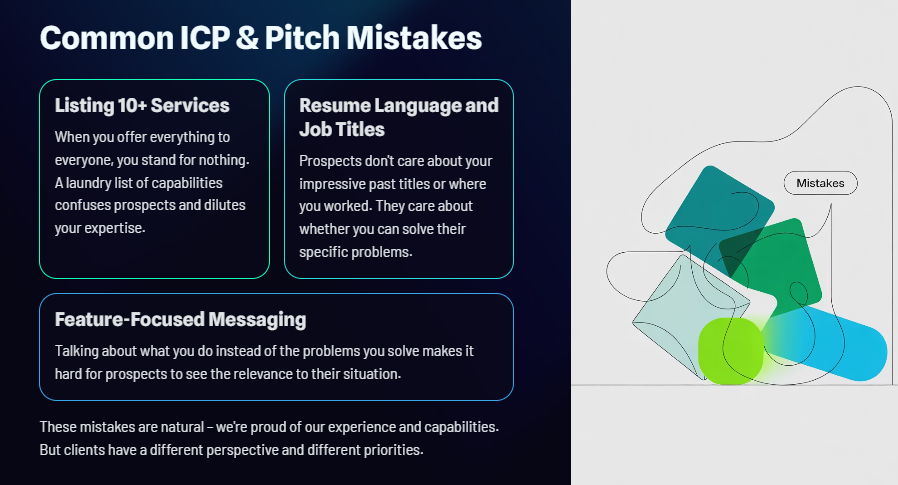
They try to sell everything they can do to everyone who might conceivably need it.
If you’ve had a long career, that’s understandable. You’ve run teams, touched different functions, led big initiatives. You can do a lot of things.
The problem is, when you list 10 or 20 things you “could” do, nobody remembers you for anything.
What most new fractionals say
A typical early‑stage pitch sounds like this:
“I can help with marketing strategy, brand, lead generation, sales enablement, CRM, content, email, social, customer experience, product launches…”
Or, from another discipline:
“I do leadership coaching, org design, process improvement, M&A integration, performance management, training, talent strategy…”
All of that might be true.
But imagine you’re a CEO or a fellow fractional hearing that in a 30‑minute coffee chat. Two weeks later, what sticks?
Usually: nothing specific.
You become “another smart person who does some kind of consulting.”
That’s not the position you want.
What happens when you pick one problem and one ICP
These days, when I talk about what I do, I say something like:
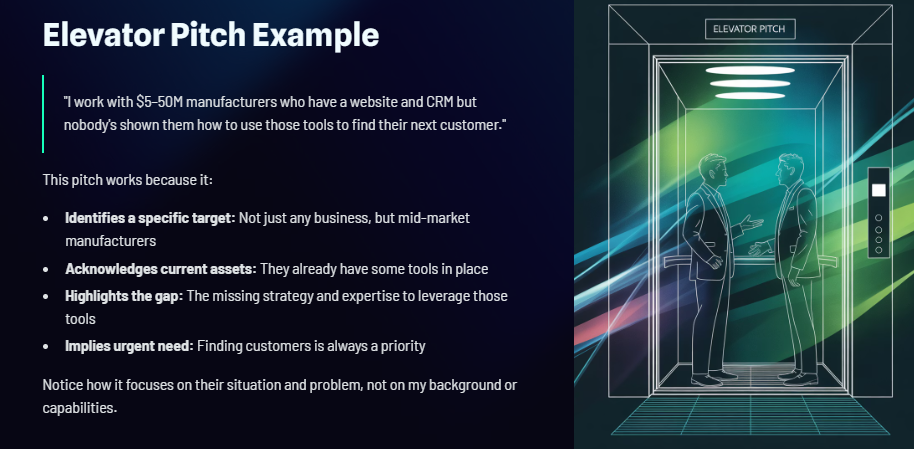
“I work with $5–$50M B2B manufacturers who have a website and a CRM, but don’t know how to use them to find their next customer.”
That’s it.
Now, in reality, once I’m engaged I might touch:
Strategy
Sales and marketing alignment
Systems and reporting
Messaging and content
Partner and channel dynamics
But that’s not what I lead with.
I lead with one specific avatar and one specific pain:
Who: 5–50M manufacturers (mid‑market, industrial context, asset‑heavy)
What they have: a website + a CRM, not integrated, under‑used
What they feel: “We grew to $20M on relationships and referrals. Now we’ve hit a plateau and we don’t know how to get to the next level.”
That’s a picture people can remember.
A few months later, I’ll hear:
“Oh right, you’re the guy who helps manufacturers that have a website and CRM they’re not getting any leads from.”
That’s exactly what you want.
The risk of being specific (and why it’s smaller than you think)
The hesitation I hear is:
“If I narrow down that much, won’t I lose opportunities?”
In theory, you might miss a few random, one‑off projects outside your lane.
In practice, by being specific:
You become referable
People know when to think of you
You start hearing, “I know a company that fits exactly what you described”
I’d much rather have:
10 people who can clearly say “This is Rob’s lane”
than
100 people who vaguely remember “Rob does some kind of marketing and digital transformation”
Being remembered for one thing is more valuable than being forgettably capable at many.
Your ICP isn’t theoretical
There’s also a practical reason my ICP looks the way it does:
I spent 25 years at 3M, mostly around industrial and B2B spaces
I’ve been in a lot of plants and small manufacturing facilities
I understand how those business models work and how those owners think
I speak their language, down to the steel‑toed boots when I visit
That’s not branding fluff. It matters in the room.
When I say “I work with manufacturers in the 5–50M range,” they can feel that I’ve seen their world. I know the difference between selling through distribution vs direct, how inventory and working capital feel, and what keeps an owner up at night.
Your ICP should come from the same place:
Industries you’ve actually lived in
Business models you already understand
Problems you’ve seen up close enough to describe in detail
If you have that, you don’t have to fake empathy. It’s built in.
How a narrow pitch makes referrals easy
The other big payoff from “one problem, one ICP” is how it simplifies referrals.
When I’m talking to:
Other fractional marketers
Fractional CFOs, COOs, HR leaders
People in my own network from past roles
…I want it to be effortless for them to know when to introduce me.
A vague pitch forces them to do work:
“Rob does some strategy and marketing and digital. I’m not sure if he’s a fit, but maybe you two should talk?”
That’s high friction.
A precise pitch sounds like:
“This client is a $30M manufacturer. They’ve got a website, they’re paying for a CRM, but no real leads are coming out of either. That’s exactly the kind of problem Rob fixes. Do you want an intro?”
That’s low friction. They know who I’m for, what I do, and when to involve me.
The clearer you are, the more other people can sell you without feeling like they’re guessing.
Yes, you can still do more once you’re inside
Narrowing your entry pitch doesn’t lock you into a tiny box forever.
Here’s what typically happens in my world:
I’m brought in to fix the “website + CRM + no leads” problem.
Over 60–90 days, I:
Talk to sales, marketing, customer service, sometimes operations
Map out their current funnel and gaps
Put some basic systems and campaigns in place
Along the way, I see:
Strategy gaps
Positioning and messaging issues
Sales process problems
Organizational misalignments
After they see the value from the initial work, they say:
“We’d love your help with these other things too. Can we extend this SOW or shift to a retainer?”
My point is: the door is narrow. Once you’re in the building, you can walk through a lot of rooms.
A simple exercise to find your own “one problem, one ICP” pitch
If you’re struggling to narrow down, here’s a process that helped me:
Talk to people who’ve worked with you before.
Former bosses, peers, direct reports, partners.
Ask them:
“What kinds of projects would you immediately think to invite me into?”
“What problems did I seem uniquely good at solving?”
“What did I think I was great at but really wasn’t?”
“What was I good at that I never gave myself credit for?”
Capture their words, not just your memory.
I recorded those conversations (with permission), transcribed them, and dumped them into a single document.
Look for patterns.
When I ran that text through a language model and asked, “What is Rob really good at?” and “What’s his unique value proposition?” three themes came back—none of which were on my LinkedIn profile at the time.
Update your public story.
I rewrote my LinkedIn, my resume, and then my website around those themes.
And then, in live conversations, I picked one problem and one ICP to lead with.
You don’t have to use AI for this. A highlighter and a free afternoon will get you most of the way there. The point is to ground your focus in how the market has experienced you, not just in what you feel like on a given day.