When people ask how I do business development, I don’t start with tactics.
If you listen to a lot of marketing advice, you’d think LinkedIn is where everything happens:
Post daily
Go viral
Leads will pour in
That hasn’t been my experience.
For the kinds of clients I work with—5–50M manufacturers and B2B companies—LinkedIn is useful, but not in the way most people talk about.
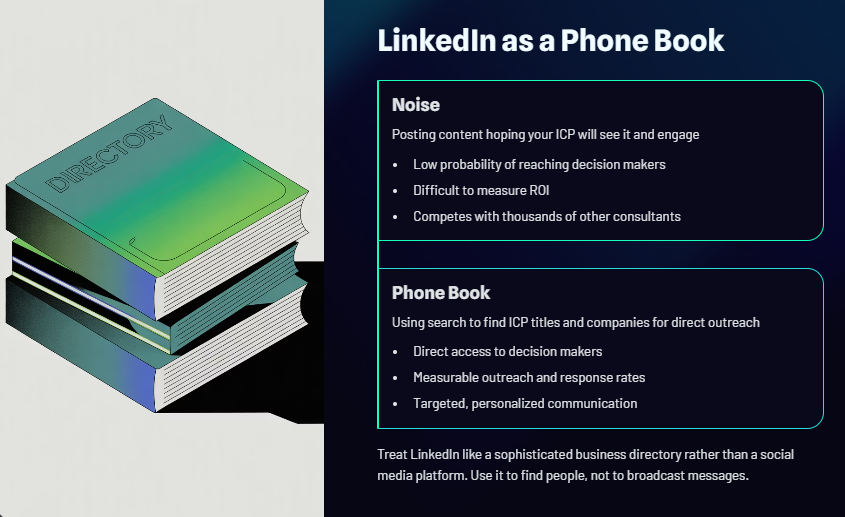
I don’t treat it as a publishing platform. I treat it as a phonebook.
Let me explain what I mean by that and how I actually use it to support my fractional practice.
Where your ideal buyers actually “live”
Most of my ideal buyers are:
Presidents
General managers
CEOs
Founders of small to mid‑sized industrial companies
They have:
Plants to run
Supply chain issues to manage
Sales teams to support
Equipment and people to worry about
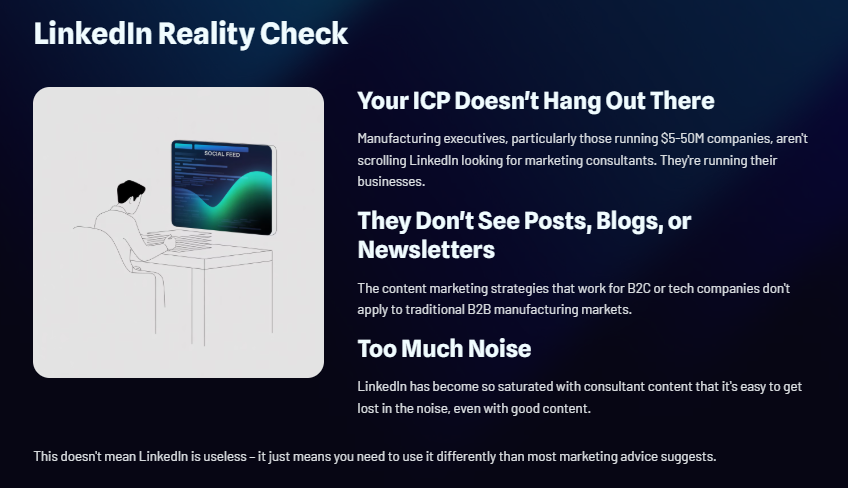
What they don’t have is a lot of free time to scroll through LinkedIn every day.
A few do. Many don’t. And almost none of them are sitting there thinking:
“I should go find a fractional CMO today.”
So if your business development strategy is built on:
Posting content multiple times a week
Hoping CEOs discover you in their feed
Expecting inbound DMs from perfect clients
…you’re probably going to be disappointed.
That doesn’t mean LinkedIn is useless. It just means the job you’re hiring it to do should be different.
The job: identifying and connecting with the right people
I use LinkedIn for two main purposes:
To find people who match my ICP
To make an initial, low‑pressure connection
That’s it.
Once that’s done, I move as quickly as possible to channels that are better suited to real conversations—primarily email and phone.
Here’s how that looks in practice.
Step 1: Define your ICP clearly enough to search for it
Everything starts with clarity about who you’re looking for.
In my case, that’s something like:
Companies:
Manufacturers
$5–50M in revenue
Based in North America (often upper Midwest for me)
People:
President, GM, CEO, owner, founder
Sometimes heads of sales/marketing, depending on the situation
LinkedIn is very good at:
Industry filters
Job titles
Company size (roughly)
Geography
If you haven’t narrowed your ICP to something that can be described in those terms, do that first. Otherwise, you’ll get lost in a sea of “interesting” but not very relevant people.
Step 2: Send simple, honest connection requests
Once I have a list, I use a tool (Dripify) to send connection requests in a way that doesn’t require me to manually click “connect” 100 times a month.
The message I send is intentionally plain:
“Hi [First Name],
I’m another executive in the manufacturing space here in Minnesota. I’m expanding my network and would be glad to connect.”
A few principles behind that:
No pitch.
I’m not asking for a call. I’m not talking about services. I’m not promising anything.
Accurate context.
We’re both in a similar space. I’m expanding my network. That’s true.
Low friction.
They can accept or ignore. No guilt either way.
My goal at this point is not to sell anything. It’s to:
Get connected
Gain access to their public email (if they’ve added one)
Capture that info in my own system for future, more thoughtful outreach
I don’t continue to message them on LinkedIn after that.
Step 3: Capture and enrich outside of LinkedIn
Once someone accepts the connection:
A Zapier workflow picks up that event from Dripify
It creates or updates a contact in my CRM (HubSpot) with:
Name
Title
Company
LinkedIn URL
Email (if visible)
Connection date
From there, I’ll enrich that contact:
Manually at first, when my list was small
Later, using a tool like Clay to pull in:
Company size
Industry specifics
Tech stack (website platform, CRM, etc.)
Any relevant signals (e‑commerce presence, distribution model, etc.)
By the time I’m ready to reach out personally, I’m not guessing. I know:
Roughly how big they are
How they go to market
Whether they’re even in the ballpark for the kind of work I do
That’s work LinkedIn is not designed to do on its own.
Step 4: Move to email for meaningful outreach
As soon as it makes sense, I move communication to email.
Why?
Email is where these leaders already run their business
It’s easier to send attachments, context, and thoughtful messages
It’s easier for them to forward things to their team
I can control cadence and content without worrying about algorithms
So a typical progression might be:
Connect on LinkedIn (simple message)
Capture and enrich their info in my CRM
Weeks or months later, send:
A one‑off personal email, or
A small‑batch “strategic interruption” email to a segment they’re part of
LinkedIn opened the door. Email is where the real conversation happens.
What about posting on LinkedIn?
I do post on LinkedIn, but my bar is low:
Roughly once a month
The goal is not to:
Build an audience
Generate huge engagement
Become a “LinkedIn influencer”
The goal is simply:
To make sure that if someone looks at my profile, they don’t see:
A ghost town
Or the last post from two years ago
A handful of posts that:
Reflect how I think
Align with my ICP and problem
Show that I’m active enough
…are sufficient for my model.
If you enjoy posting more often and it’s working for you, that’s fine. Just don’t confuse “activity on LinkedIn” with “building a sustainable fractional business.”
For my world, posting is a supporting tactic, not the primary engine.
Why I call it a phonebook
When I say I treat LinkedIn as a phonebook, I mean:
It helps me find names and organizations that match my ideal profile
It gives me a way to say a brief, polite “hello”
It exposes contact info that I can pull into my own system
After that, I’m not depending on it.
I’m not:
Watching the feed all day
Competing for attention in a noisy environment
Banking my pipeline on how many likes I get
Instead, I’m:
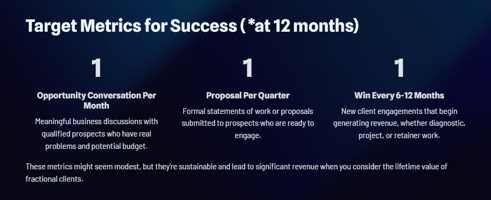
Having 10–ish real conversations a month
Building a segmented, enriched list
Sending a thoughtful, highly relevant email to the right 50–100 people a few times a year
Progressing people through diagnostics, SOWs, and retainers over a 6–8 month cycle
LinkedIn is just the front door into that process.
How to right‑size LinkedIn in your own strategy
If you’re a fractional and LinkedIn has been stressing you out, here’s how I’d reset:
Clarify your ICP and problem.
Make sure you can describe:
The industries
Company sizes
Titles
Problems
…you’re aiming at, in terms LinkedIn can search on.
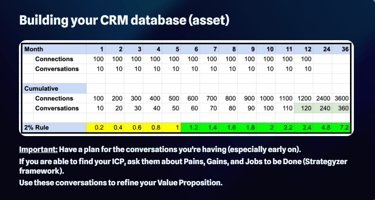
Set a modest connection target.
Something like:
100 connection requests/month
Sent with a simple, honest note
No pitch in the first touch
Invest in your off‑LinkedIn system.
A basic CRM or even a spreadsheet
Some way of tracking:
Who you’ve connected with
What you know about them
When to follow up
Use LinkedIn posts sparingly and intentionally.
Once or twice a month
Focus on:
The problem you solve
The kinds of companies you work with
Occasional lessons or stories from your world
Measure what actually matters.
Instead of:
Likes, impressions, followers
Focus on:
Conversations held
Diagnostics booked
SOWs and retainers signed
When you see LinkedIn as a tool for identification and introduction, instead of a magic lead source, a lot of pressure comes off.
You can stop trying to win the content game and start using it for what it’s actually good at:
Finding the right people, getting just close enough to say “hello,” and then moving the relationship to a place where serious business decisions are actually made.